Traits are your leadership wiring — the stable patterns in how you think, react, and operate across situations. They fuel your strengths, shape your style, and influence how others experience you. But when a trait is pushed too far, or when the context changes faster than you do, those same strengths can quietly turn into blindspots. Self-awareness doesn’t change your wiring; it helps you recognize when a trait is tipping into overdrive so you can manage your behavior with intention instead of instinct.
Every leader has qualities that feel deeply familiar — the ways you naturally make decisions, approach relationships, handle stress, or move through a room. Some leaders move fast, trusting instinct. Others slow down, gathering data before speaking. Some diffuse tension with empathy. Others push forward with confidence.
These patterns aren’t random. They’re traits — the enduring qualities that tend to appear across moments, roles, and seasons of life.
Traits shape your “default settings”: how quickly you react, how openly you share ideas, how comfortable you are with conflict, how much information you need to act. They aren’t temporary states or learned skills — they’re consistent patterns that influence everything from tone to timing to tolerance for uncertainty.
As Martin Dubin, PhD writes in Blindspotting: How to See What’s Holding You Back as a Leader:
“Traits are … stable and consistent across our lifespan.”
This is why two people can experience the same situation but respond in completely different ways. Even when circumstances change, the underlying pattern remains.
Dubin explains:
“Someone who has the trait of confidence may have moments when they don’t feel confident, but for the most part they are confident in a wide range of situations.”
Because traits are so enduring, they are difficult — often impossible — to change:
“Traits are hard to change… any attempt to change them is likely to end in frustration and failure.”
The goal of leadership, then, is not to become someone else. It’s to understand your wiring clearly enough to use it wisely.
Traits create the starting point. Behavior is how you manage them.
With awareness, leaders learn when to lean into a trait, when to turn it down, and when to rely on others whose strengths complement their own. As Dubin notes:
“It is almost always more productive to become aware of our traits and then manage around them or find a role where we can thrive because of our unique gifts and abilities.”
Traits aren’t limitations — they’re leverage. But only when you can see them clearly.
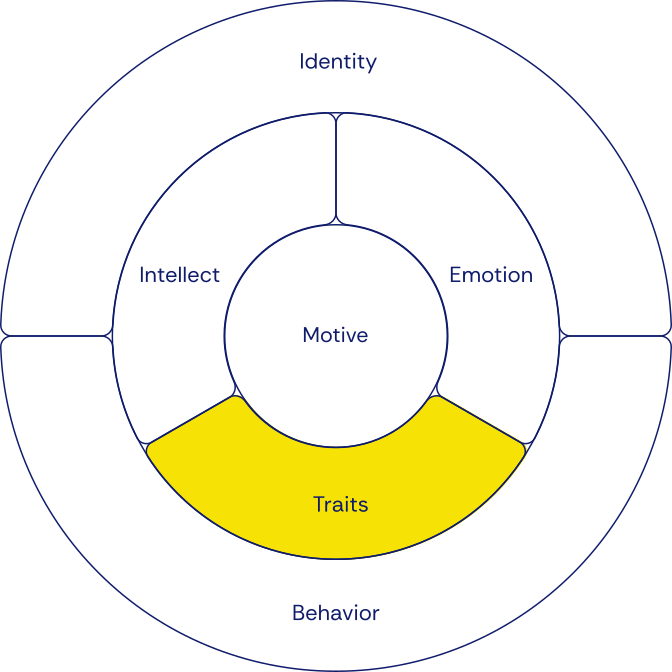
In the Blindspotting Self-Awareness Model, Traits live in the same internal layer as Intellect and Emotion — beneath the outer layers of Identity and Behavior, and above the deepest layer, Motive.
This middle layer is where many blindspots take root. It includes:
Together, these three elements shape how leaders interpret situations, make decisions, and respond under pressure.
Because this layer sits:
it becomes incredibly influential — but not always obvious.
Traits, Intellect, and Emotion all operate automatically unless you slow down to examine them. They subtly steer behavior, tone, timing, decision-making, relationships, and reactions.
When this middle layer goes unexamined, the outer layers begin to wobble:
This is why trait blindspots — along with intellect and emotion blindspots — often go unnoticed the longest, yet have the biggest impact on how leaders show up.
Every trait begins as a strength.
But strengths have a tipping point.
A trait becomes a blindspot when its intensity, timing, or context shifts — often without the leader noticing.
Under stress, success, pressure, or rapid change, traits tend to amplify. What once helped you now begins to work against you.
Blindspots form not because traits are bad, but because they are unregulated. Awareness is what separates strengths from liabilities.
A compelling example of trait blindspots can be told about Miguel and Brendan — two cofounders whose opposite tendencies powered a thriving company, then nearly fractured it.
Miguel was exceptionally gifted: very high in openness, confidence, and perseverance, and extremely low in accommodation. As the book notes:
“His curiosity, persistence, and bias to action really were superstrengths.”
But as the company scaled, those same traits tipped into liabilities. He dismissed competing priorities, pushed past reasonable limits, and overwhelmed the people around him. Dubin writes:
“He did not see how his curiosity led to a lack of practicality; how his persistence meant he didn’t know when to back down.”
His wiring wasn’t wrong — but it was unchecked.
Brendan’s key traits were loyalty, responsibility, and agreeableness. They made him steady, reliable, and trustworthy.
But those same qualities trapped him in hesitation, even as senior leaders began leaving the company. As the manuscript explains:
“Loyalty and responsibility were keeping him from doing what needed to be done.”
Two extremes. Two blindspots. One breaking point.
Coaching made something clear: neither leader needed to change their traits — but the business needed a different structure around them.
Brendan uncovered a role where Miguel’s traits would thrive instead of conflict: teaching and mentoring students at a local tech college.
Miguel chose the new direction.
The transition was smooth. The company stabilized rapidly.
Lesson: Trait blindspots aren’t always solved by changing the person. Sometimes they’re solved by changing the context so the trait fits.
Read the full Miguel & Brendan story→
Trait blindspots often feel personal because traits live in the space between how we see ourselves and how others experience us. When feedback touches this layer, it can sound like a judgment of character rather than behavior:
Marty Dubin, PhD uses a simple tool to reveal the tipping point of a trait: put the word “too” in front of it.
If the “too” version feels true — even occasionally — you’ve spotted the moment when a strength becomes a blindspot.
Traits sit just beneath Behavior in the Blindspotting Self-Awareness Model. They’re stable and consistent, which means they operate automatically unless you slow down to notice when they’re running ahead of you. Awareness doesn’t change your wiring; it helps you manage when a strong trait is tipping into overdrive so you can adjust before it affects the people around you.
Blindspotting Performance Coaching helps leaders:
It’s not about changing who you are. It’s about using who you are more intentionally.
Learn more about Blindspotting Performance Coaching for individuals and teams →
Consider:
The question is whether they’re guiding you forward or pulling you into blindspots.
→ Explore Blindspotting Coaching for Leaders & Teams
Blindspotting → Identity → Behaviors → Traits → Intellect → Emotion → Motive →


