.png)
Intellect is the pace, depth, and style of your thinking — how you take in information, interpret complexity, and make decisions. But intellect isn’t one single trait. Blindspotting identifies four types of intellect, and leaders tend to rely heavily on one while unintentionally dismissing the others. When a leader overuses their preferred thinking style or fails to appreciate the value of the other types, intellect becomes a blindspot — not because they’re “overthinking,” but because they’re thinking in only one way.
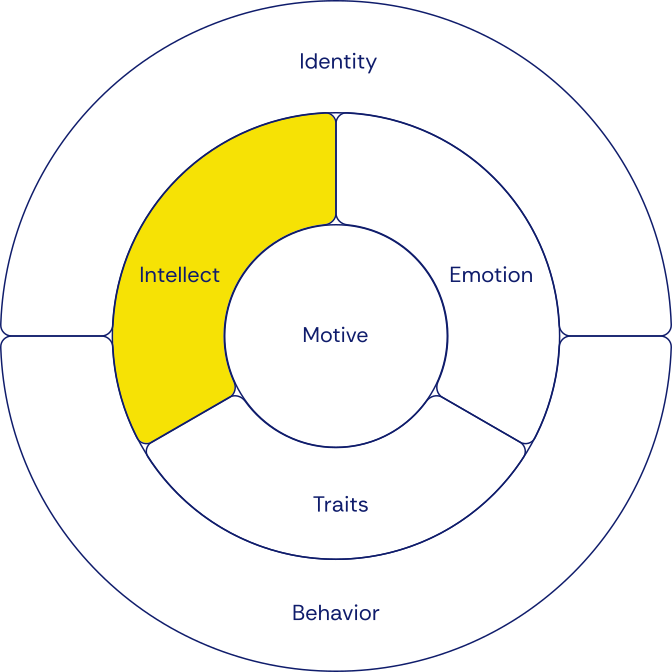
In Blindspotting: How to See What’s Holding You Back as a Leader, Martin Dubin, describes Intellect as the system that shapes how we “take in, organize, and make sense of information.” It is one of the most influential forces in leadership performance — not because intelligence is rare, but because leaders differ dramatically in the type of intelligence they rely on.
A common misconception in leadership is that “the smartest person in the room” is the best leader. Blindspotting argues the opposite: intelligence comes in multiple forms, and leadership requires all of them.
In the Blindspotting Self-Awareness Model, Intellect sits in the middle layer, alongside Traits and Emotion — beneath Identity and Behavior, and above Motive. This makes it powerful and easy to overlook.
Blindspotting defines four core intellect types every leader uses — and often overuses:
Leaders strong in horsepower can retain and synthesize huge amounts of information, learn new concepts quickly, connect details, separate what matters from the noise, and express conclusions with clarity.
Blindspot: When their intellectual engine runs too fast for others to follow — creating rapid-fire conclusions that overwhelm, shut down discussion, or bypass perspectives that move at a different pace.
Fast processors see patterns instantly. They reach conclusions quickly, ask sharp questions, and accelerate decisions.
Blindspot: When their speed outpaces others’ ability to follow, shutting down dialogue or creating intimidation.
These leaders generate ideas, spot patterns, and imagine possibilities. They see connections others overlook.
Blindspot: When imagination outruns practicality, or when they lose interest in essential details necessary for execution.
These leaders read people, timing, nuance, and risk. They navigate ambiguity and make decisive calls.
Blindspot: When instinct overrides evidence, creating blind optimism or miscalculations.
In Blindspotting: How to See What’s Holding You Back as a Leader, Martin Dubin, introduces a concept that sits alongside the four types of intellect: knowledge acquisition. While horsepower, processing speed, creativity, and street smarts describe how leaders think, knowledge acquisition describes how leaders continue learning.
Knowledge acquisition is the discipline of continually gathering new information, perspectives, and insight — especially from sources outside your immediate expertise. It protects leaders from what Dubin calls the “Blind Zone,” the moment when intellect becomes fixed, automatic, or closed to new input.
Leaders strong in knowledge acquisition:
Knowledge acquisition isn’t about accumulating facts. It’s about staying open — ensuring intellect never becomes rigid, isolated, or over-relied upon.
In Dubin’s model, knowledge acquisition is the balancing mechanism that keeps intellect from becoming a blindspot. It broadens perspective, deepens understanding, and ensures leaders stay connected to what’s changing around them.
As Dubin explains:
“A failure to include all four types of intellect in decision-making — or an overemphasis on one while ignoring the others — means you are suffering from an Intellect Blindspot.”
It’s not about overthinking. It’s about overusing.
A fifth-generation family jam business needed a new CEO. Four cousins emerged as candidates — each exceptionally intelligent, but each intelligent in a different way.
Each cousin’s intellect had a corresponding overuse:
The book makes the lesson clear: the issue wasn’t intelligence — it was imbalance.
Instead of choosing one cousin, the family created a leadership structure that leveraged all four intellect styles, preventing any single strength from becoming a blindspot.
Read the full Jam Company story. →
Sophie, a partner at a leading VC firm, could see flaws in a pitch in seconds. Her speed made her indispensable — and intimidating.
She interrupted quickly. She processed faster than founders could speak. She corrected people mid-sentence. She believed speed was synonymous with excellence.
Founders dreaded meeting with her not because she was wrong — but because she was unrelatable, unapproachable, and uncollaborative.
Her fast processing became a blindspot because she couldn’t see the interpersonal cost of her speed.
Mordecai, a regional bank CEO, avoided intellect blindspots in an entirely different way: he treated leadership as continuous intelligence gathering.
He walked the halls to hear frontline insight. He spoke with his external network weekly. He asked genuine questions. He listened more than he explained.
His strength wasn’t raw intelligence — it was never assuming he had enough intelligence.
Mordecai’s discipline kept him out of what Dubin calls “the Blind Zone” — the moment when intellect becomes closed, automatic, or unexamined.
Read the full Mordecai story. →
These stories show the same pattern:
Intellect becomes a blindspot when one thinking style crowds out the others.
This happens when:
A thinking style becomes a blindspot the moment it becomes automatic.
The blindspot isn’t what you know — it’s what your preferred style prevents you from seeing.
Blindspotting Coaching (the Blindspotting Performance Experience) helps leaders:
Coaching is not about “thinking less.”
It’s about thinking more balanced, more aware, and more strategically.
Ask yourself:
Horsepower:
Speed:
Creative Intelligence:
Street Smarts:
Your intellect is one of your greatest strengths — but it becomes even more powerful when you see its limits and learn to balance it.
→ Explore Blindspotting Coaching for Leaders & Teams
Blindspotting → Identity → Behaviors → Traits → Intellect → Emotion → Motive →


