
Leadership transitions—promotions, new roles, or periods of growth—often feel more difficult than expected. As leaders transition into a new role, they often hold on to an identity from their previous role that no longer fits. That mismatch creates blindspots that affect behavior, decision-making, and team performance. Awareness is what allows leaders to recognize that gap, adjust how they show up, and move forward with greater clarity and alignment.
Most careers are defined by a series of transitions. You step into a new role, take on broader responsibility, or move into a more complex environment. From the outside, these moments signal progress. They reflect trust, capability, and advancement.
But from the inside, they often feel a lot more complicated.
Things that once felt natural now require more effort. Decisions don’t land the same way. You may find yourself pulled back toward work you used to do well, even when it’s no longer your job.
It’s easy to assume this is just part of the learning curve. And to some extent, it is.
But often, something deeper is happening.
The role has changed. But your identity hasn’t ... yet.
Every leader develops an identity around their work over time. It’s shaped by what they’ve been rewarded for, where they’ve succeeded, and how they’ve learned to create value.
That identity becomes a lens through which we choose to operate. It influences:
In a stable position, that lens is in alignment with the needs of the role. But often, in a transition, that old lens no longer fits.
When expectations shift but identity stays the same, a blindspot forms.
Not because anything is wrong with how you see yourself—but because what used to work no longer fits what’s required now.
If we don’t learn to adjust our identity during transitional moments, the challenges can snowball.
Transitions expose identity faster than almost anything else, because they force a mismatch between:
That mismatch shows up in a handful of predictable ways.
One of the most common transitions in business is moving from doing the work to leading others who do it.
You were promoted because you were effective. You delivered and knew how to get things done.
Now the expectation has shifted, and your role is no longer to produce. It’s to create the conditions for others to produce.
That shift is not just operational in nature—it’s also deeply personal.
Many leaders struggle here because their identity is still tightly bound to execution. They continue to prioritize the work itself, even when the role requires them to prioritize people.
This is where the concept of promotion grief comes into play.
“Too often, employees and companies underestimate the psychological process inherent in moving up the corporate ladder,” says Martin Dubin, PhD, in the Psychology Today article, “Are You Suffering from Promotion Grief?”
You lose something when you move from one role to the next:
And without recognizing that loss, it’s easy to allow yourself to fall into old patterns of work.
In the book Blindspotting, author Martin Dubin shares Helen’s story.
She was a graphic designer who stepped into a management role but continued to see herself as a designer. She stayed close to the work, avoided fully stepping into leadership, and limited her impact. Helen never shifted her identity to align with her new role.
Sometimes the role doesn’t change dramatically—but the environment does.
You move to a new company, a new team, or step into a situation with different expectations around how decisions are made and work gets done.
What worked before doesn’t translate as easily as expected. And the confusion starts.
Leaders in these situations typically know they’re capable. They’ve done this work before. But the same instincts no longer produce the same results.
The issue isn’t ability—it’s an identity that hasn’t adapted to the new context.
They’re still operating from who they were in a previous environment, applying the same patterns in a situation that requires something different.
Some transitions don’t just require you to lead differently. They require you to step away altogether.
Succession and retirement bring a unique kind of identity challenge. One that isn’t about adapting your role, but redefining it entirely.
For many leaders, especially those who have spent years or decades building something, their identity is deeply tied to their position. It’s not just what they do. It’s who they see themselves as.
They are:
Letting go of the position can feel like more than simply a transition. It can feel like a loss. Because it is one.
Even when it’s planned and the right move for all parties involved.
There tends to be a hint of resistance in these situations—often subconsciously.
Leaders may:
It has nothing to do with their trust in others to succeed without them. It’s about the fact that their identity is still strongly anchored to the role they’re stepping out of.
This is where the identity blindspot becomes especially challenging.
The organization may be ready to move forward. But the leader is still holding onto a version of themselves that no longer fits the future of the business.
And without awareness, that tension can impede or complicate what should be a natural transition.
Startups and rapidly growing businesses present a couple of unique and specific growth challenges.
The identity challenges that show up in leadership transitions are often most visible in startup environments.
In the earliest stage, founders operate as innovators—the ones who create, move quickly, and push an idea into the market. Speed and instinct drive progress.
As the company gains traction, the role shifts. The business no longer needs only innovation—it needs to be built. Structure, process, and consistency begin to matter, and the founder must step into the role of business builder.
As the company continues to grow, the expectations shift again. What’s required is leadership—aligning people, setting direction, and building something that can thrive beyond the founder.
The progression of roles is clear: innovator > business builder > leader.
What’s less clear is whether a founder’s identity evolves with the business.
Many founders stay stuck in the role of innovator, even as the business requires something different. The behaviors that once created momentum—speed, autonomy, direct control—carry forward into a context that no longer calls for them.
And without recognizing that shift, the identity that built the business can begin to limit its ability to evolve and scale.
Another story from Blindspotting highlights Fernando’s experience. As a founder, his success came from speed, autonomy, and decisive action. But when he moved into a corporate setting, those same behaviors created tension.
Nothing about his capability changed. The context did. And without adjusting how he understood his role, his behavior stayed the same, even when the situation required him to shift.
A similar pattern shows up not just with founders, but across entire leadership teams in growing companies.
In the early stages, leadership tends to be informal. A small group moves quickly, makes decisions together, and fills gaps as needed. Leaders often develop a shared identity—builders, problem-solvers, people who step in wherever needed to keep the business progressing.
At that stage, the identity fits the work.
As the business grows, the context begins to change. New functions emerge—finance, operations, manufacturing. New leaders are brought in, often with different expectations around structure and accountability. The organization becomes more complex, and leadership is no longer just about doing what’s needed—it’s about defining ownership, aligning teams, and operating with greater consistency.
But the identity of the leadership team doesn’t automatically evolve with that shift.
Leaders may still see themselves as generalists, stepping into everything, making decisions collectively, staying close to the work. Those patterns once created speed and momentum.
In a more mature organization, they can create confusion.
This is how an identity blindspot can afflict an entire leadership team. The team continues to operate from who they have been, rather than who the business now requires them to be.
Without awareness, that gap shows up as:
The company is maturing, but identity blindspots are holding it back.
The question is whether the leadership team is willing to let go of the identity that built the business—and step into one that can sustain it.
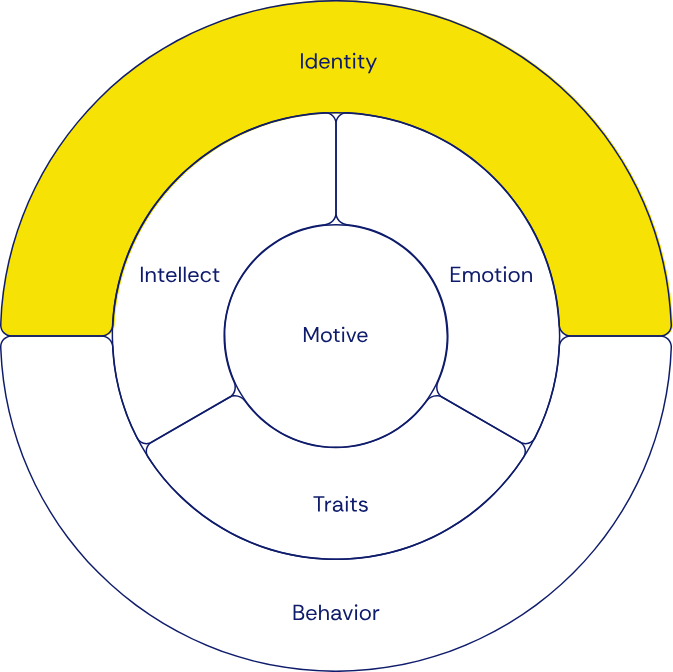
Identity sits on the outside layer of self-awareness, which means it’s technically one of the easier blindspots to recognize and evolve, once you know to look for it.
But that doesn’t make it easy to adjust.
Identity is directly tied to:
When a role requires an identity shift, the adjustment isn’t just about learning new skills or behaviors. It’s about letting go.
And that’s where many leaders get stuck.
Identity blindspots rarely show up as obvious failure. They more often show up as patterns that are harder to diagnose.
You might notice that you’ve been:
From the outside, this can look like a performance issue or a team problem.
More often, it’s a mismatch between one’s identity and their role.
As Martin Dubin, PhD explains in this recent webinar,
“Identity is like a filter. It tells us what to pay attention to and what not to pay attention to.”
When our identity filter doesn’t align with our current role, the work that actually matters can fall through the cracks.
There’s no shortcut through this transition—but there is a way to navigate it more effectively.
It starts with awareness.
Not just “I need to lead differently,” but:
From there, the focus shifts to behavior in context.
What worked before may not work now, because the environment has changed.
Leadership is not about abandoning your strengths. It’s about using them differently as the context changes.
One of the more honest outcomes of this work is that awareness doesn’t always lead to adaptation.
Sometimes, it leads to clarity.
Helen chose to return to design. Fernando chose to build again.
Neither outcome meant failure. Both were examples of discovering true alignment.
That’s the actual role of awareness—not to force change, but to make the need for it conscious.
Every leader will face transitions. The question isn’t whether your role will change. It’s whether you’ll recognize how that change impacts how you need to show up.
When identity and role are aligned, leadership feels more natural. When they’re not, it feels much harder than it should.
Remind yourself that every transition is an opportunity for growth and a process of evolution. And no one should take on that process alone.
Start building awareness that helps you lead with clarity and alignment.


